
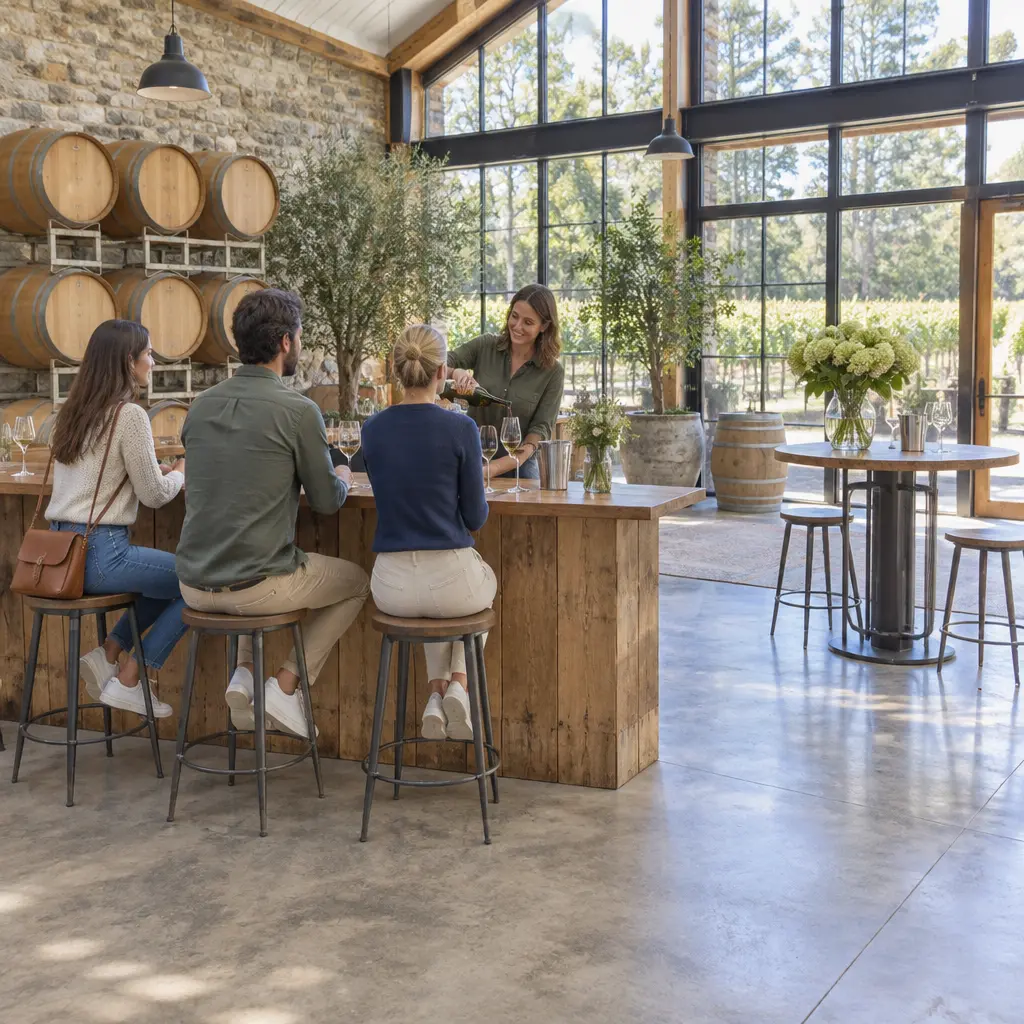
Cellar door seating gives winery visitors a place to pause, taste, and talk, while standing bar service is designed for quicker, more flexible tastings at a counter. The better choice depends on the venue’s space, visitor mix, service style, and accessibility needs. A 2023 WineBusiness Monthly survey of U.S. wineries found that tasting-room experiences and direct-to-consumer sales remain important parts of winery business, but there is no universal seating formula: operators must balance comfort and dwell time against guest capacity, staffing, and turnover. Comparing the two formats reveals how each affects hospitality, operations, accessibility, and the design of a memorable tasting.
How Cellar Door Seating Shapes Winery Hospitality
Cellar door seating is a tasting-room arrangement in which guests sample wine while seated at a table, counter stool, lounge seat, or reserved tasting station. “Cellar door” is especially common in Australia and New Zealand for a winery’s visitor-facing tasting and sales venue. Wine Australia describes cellar doors as places where visitors can taste and purchase wines and learn about the winery; the term refers to the visitor experience, not to one fixed seating plan.
Seating changes the character of a tasting: it encourages guests to settle in, ask questions, and spend more time with a host. It can suit guided flights, food pairings, groups, and visitors who need a stable place to sit. The trade-off is that each occupied seat may remain in use longer than a standing tasting position, limiting how many parties can be served during a busy period.
Table and lounge seating
Table seating consists of individual or shared tables, while lounge seating uses sofas or armchairs for a more relaxed visit. Both formats support longer conversations and can make a winery feel more like a destination than a quick tasting stop. They are particularly useful for reserved experiences, wine-and-food service, and visitors who prefer a slower pace. Their footprint is larger than that of a narrow bar, so operators need to consider circulation routes, service access, and the number of guests the room can accommodate.
Counter seating
Counter seating places guests on stools at a tasting counter, combining the stability of a seat with close access to the server. It can make it easier to present several wines, answer questions, and set down tasting notes or water. Counter seating is not the same as standing bar service: guests remain seated, and the service can still be structured as a guided tasting. The distinction matters when planning counter height, stool spacing, reach, and accessible alternatives.
Because seated formats encourage lingering, their value is not measured only by the number of guests served per hour. A well-hosted visit can support product discovery and direct sales. The 2024 Direct-to-Consumer Wine Shipping Report by Sovos ShipCompliant and Wines Vines Analytics tracks the importance of winery-to-consumer sales, while emphasizing that channel results vary by winery and market. The report does not establish that seating alone increases purchases; operators should assess their own tasting-room data rather than assume a sales effect.
How Standing Bar Service Shapes Tasting-Room Operations
Standing bar service is a tasting format in which guests remain on their feet at a counter or bar while a host pours and explains wines. It is common for walk-in tastings, busy service periods, and venues seeking a lively, informal atmosphere. Compared with a fully seated tasting, standing service can allow more guests to gather along a serving surface and can make it easier for staff to move between parties. Actual capacity depends on counter length, staffing, room layout, and local safety requirements.
Standing service is a format, not a guarantee of faster service. A host giving an in-depth flight to a large group may serve guests slowly even when everyone is standing. Conversely, a short, self-guided tasting can move quickly from a seated station. The useful comparison is therefore between service designs—such as guided, hosted, or abbreviated tastings—not simply between standing and sitting.
Walk-up bar tasting
A walk-up bar tasting is an informal service in which guests approach the counter, select or receive a tasting flight, and speak with staff as time allows. It works well for spontaneous visits and can accommodate changes in guest volume without requiring a table reservation for every party. The format is strongest when the menu, pour sizes, and service sequence are clear. Without those cues, guests may crowd the counter or struggle to know when to order.
High-top and mixed-height service
High-top tables and counters create a middle ground: guests can stand or use stools, and smaller groups can gather without occupying a full dining table. A mixed-height room can distribute visitors more flexibly than an all-bar layout. However, high surfaces should not be treated as an accessible solution by themselves; venues should provide seating and service positions that work for people with different mobility and reach needs.
Guest flow and service pace
Guest flow describes how visitors enter, order, taste, and leave without obstructing others or staff. Standing bars can make transitions more visible, but only when there is room for waiting guests, clear ordering points, and safe access to exits. The U.S. Access Board’s accessibility standards set requirements for accessible routes and sales and service counters in covered facilities; winery operators should consult applicable federal, state, and local requirements when designing or renovating a tasting room.
These operating differences connect directly to guest experience. A bar may offer energy and spontaneity, while seating can signal time, attention, and comfort. Neither format is inherently more welcoming; the result depends on how staff guide the experience and whether visitors can choose a suitable way to participate.
Comparing Cellar Door Seating and Standing Bar Service
The central distinction is the balance between a stable place to settle and an open service position that supports movement. Seated service often gives guests more room for conversation and food, while standing service can make casual walk-ins easier to accommodate. A practical comparison should include comfort, capacity, service duration, accessibility, and the winery’s intended brand experience.
- Comfort: Seating offers a place to rest and can support longer tastings. Standing service may be uncomfortable for guests who cannot stand for extended periods.
- Capacity: Bars can use wall or counter space efficiently, but usable capacity is constrained by safe circulation and service access. Tables require more floor area per group.
- Experience: Seated tastings can feel deliberate and personal; standing tastings can feel social and spontaneous. Host behavior matters more than furniture alone.
- Service design: Flights, pairings, and detailed explanations may work naturally at a seated station. A concise menu and clear sequence help keep standing service organized.
- Accessibility: A venue should provide practical choices, including accessible routes and service points, rather than assuming every guest can use a standard-height counter or remain standing.
Comfort, accessibility, and visitor choice
Accessibility means that guests with different abilities can reach and use the tasting experience. The Centers for Disease Control and Prevention reports that about one in four U.S. adults has a disability, a reminder that inclusive design affects a substantial part of the population. That national figure is not a measure of winery visitors, but it reinforces the need to consider seating, clear routes, accessible counters, and service alternatives. Providing a mix of seated and standing options lets guests choose without requiring them to explain a personal need.
Capacity, dwell time, and revenue
Dwell time is the period a guest spends in the tasting room; turnover is how quickly a tasting position becomes available to the next party. Longer visits can create opportunities for deeper engagement, but they may also reduce the number of parties served during peak periods. Standing service may increase flexibility, yet a crowded bar can harm comfort and slow staff. Wineries can compare formats by tracking reservations, walk-in waits, tasting duration, wine purchases, and guest feedback across comparable service periods. No general industry statistic proves that one layout produces higher revenue in every winery.
Brand fit and real-world application
A small estate offering appointment-based, host-led flights may find that seated tables support its educational style. A high-traffic winery with frequent walk-ins may use a standing bar for casual tastings while reserving tables for food pairings or groups. A mixed model can serve both purposes: for example, a central counter for walk-ins, a limited number of accessible tables, and reservable seated experiences. These are design examples, not a claim that one arrangement is universally best; the right choice depends on the property’s visitors, staffing, and service goals.
Choosing a Tasting-Room Format
A winery can make a sound choice by starting with its service promise, then testing how the room performs. Before construction or a major renovation, map the guest journey from arrival to departure, identify where queues form, and confirm that staff can reach guests without crossing congested areas. Review accessibility obligations with a qualified professional and include seating choices in the plan.
- Define the main experience: quick walk-in tasting, guided flight, food pairing, group visit, or a combination.
- Estimate peak demand and staffing, then test the layout during busy and quiet periods.
- Provide a choice of seating and standing positions where feasible, with accessible routes and service options.
- Track wait times, tasting duration, guest comments, sales per visit, and staff workload.
- Adjust reservations, menus, furniture, and service scripts based on observed results rather than assumptions.
A simple comparison chart can help teams review the trade-offs: place comfort, service pace, capacity, accessibility, and brand fit in rows, then assess seated, standing, and mixed formats against each measure. The chart should use the winery’s own observations; industry-wide averages cannot substitute for local visitor patterns.
Conclusion: Match Seating to the Tasting Experience
Cellar door seating supports comfort, conversation, and extended tastings, while standing bar service can accommodate informal walk-ins and create a lively point of interaction. Counter seating, high-tops, and mixed layouts offer additional options. The most effective format balances guest choice, accessibility, room capacity, staff workflow, and the winery’s hospitality goals. Operators should measure how their own visitors use the space, consult accessibility standards, and refine the layout accordingly. For further planning, review Wine Australia’s visitor-experience resources, the U.S. Access Board’s accessibility standards, and winery direct-to-consumer research.
Sources: Wine Australia, “Cellar Door Experiences,” https://www.wineaustralia.com/; WineBusiness Monthly, “2023 Tasting Room Survey,” https://www.winebusiness.com/; Sovos ShipCompliant and Wines Vines Analytics, “2024 Direct-to-Consumer Wine Shipping Report,” https://www.sovos.com/; U.S. Access Board, “ADA Accessibility Standards,” https://www.access-board.gov/ada/; Centers for Disease Control and Prevention, “Disability Impacts All of Us,” https://www.cdc.gov/disability-and-health/articles-documents/disability-impacts-all-of-us.html.